al-luckylady

Friday, March 19, 2021

Dong Po Rou


Dong Po Rou is pork belly cooked in light and dark soy sauces, Chinese cooking wine, spring onion, ginger, cinnamon stick, star anise, brown sugar and water. I seldom use cinnamon stick and star anise in my day-to-day cooking except when I am cooking curry. However, when I use them to cook the pork belly, these ingredients plus the Chinese cooking wine give out a very distinctive sweet aroma 


Ingredients:
  • 450 g pork belly
  • 50 g spring onion
  • 2 inches of ginger, sliced
  • 1 piece of 5 inch long cinnamon stick
  • 2 small pieces of star anise
  • 30 g brown sugar
  • 150 g light soy sauce
  • 100 g Chinese cooking wine (Shaoxing Huatiao Chiew)
  • 15-20 g dark soy sauce (Dish will be bitter if more is added.)
  • Water, approx 500 g

Method:
  • Use a knife to scrape the skin of the pork belly to remove any impurities.
  • Remove any hair from the skin of the pork belly. Wash the pork belly.
  • Boil a pot of water. When the water has boiled, put the pork belly into the pot skin side down.
  • Lower the heat and blanch the pork for about 10 minutes.
  • Remove any scum that floats up to the surface.
  • Once the time is up, remove the pork belly and rinse it under running water.
  • Cut the pork into cubes of at least 2 inches by 2 inches.
  • Tie the cubes with butcher's string. This is to prevent the pork belly from falling apart as it will be cooked till very soft (melt in the mouth). Set aside.
  • Prepare a pot to cook the pork belly.
  • Cut the spring onions into 6-inch length.
  • Line the spring onions on the bottom of the pot. This is to prevent the skin of the pork belly from sticking to the pot.
  • Next add the ginger slices to the pot.
  • Arrange the pork belly on top of the spring onion skin side down.
  • Add brown sugar to the pot.
  • Add cinnamon sticks and star anise to the pot.
  • Add Chinese cooking wine (Shiaoxing Huatiao Chiew) to the pot.
  • Add light soy sauce to the pot.
  • Add dark soy sauce.
  • Add water, enough to cover the pork belly.
  • Cover the pot and cook the pork belly over low-medium heat for at least 20 hours. Check every now and then to ensure that the pot does not dry up. Add water if required.
  • When the melt-in-the-mouth texture is achieved (approx. 2 hours), reduce the sauce in the pot till about 1 inch is left.
  • Remove the pork belly from the pot and remove the butcher's string.
  • Gently arrange the pork belly on a serving dish with some sauce on it.
  • Serve with rice.

Tuesday, March 16, 2021

Baked Cheesy Seafood Fried Rice


I am sure all of us will fry rice once in a while especially when we have lots of cooked rice in our fridge or when we are short of time to cook a full meal or when we run out of idea on what to cook. Fried Rice is the easiest meal to cook up, a single pot with all the required carbohydrate, protein, fats, minerals and vitamins in it. I usually add a combination of such ingredients as eggs, prawns, char siew, carrots, peas, maize, long beans, cabbage, onion and bird eyes chilies in my fried rice. Another delicious way of frying rice is to add sambal and crispy anchovies to it.

I brought my simple fried rice to another level by adding cheese and baking it. It is simply delicious for the palate.


Ingredients:

  • 200 g overnight rice
  • 1 egg
  • 75 g fish fillet
  • 75 g prawns
  • 75 g squids
  • 1 tbsp butter
  • 3 cloves garlic, chopped and divided into 2
  • 1 tbsp flour
  • 125 g milk
  • 1/2 tsp + 1/2 tsp salt
  • 1/2 tsp + 1/2 tsp white pepper powder
  • 100 g grated Mozzarella cheese
  • 4 tbsp cooking oil

Method:
  • Heat up the kuali with cooking oil.
  • Fry the fish fillet till cooked. Ladle up and set aside.
  • Add prawns to the kuali and fry till cooked. Ladle up and set aside.
  • Add squids to the kuali and fry till cooked. Ladle up and set aside.
  • Add half of the chopped garlic to the kuali.
  • When the garlic is fragrant, add rice to the kuali.
  • Break the egg onto the rice. Fry the rice till it is dry.
  • Add 1/2 tsp of salt and 1/2 tsp of pepper to the rice. Fry the rice till the seasonings are incorporated.
  • Ladle up the rice into a baking dish. Set aside.
  • Add butter to a saucepan. Let the butter melt over medium heat.
  • Saute the remaining chopped garlic till fragrant.
  • Add flour to the butter, stirring continuously till both are fully incorporated to form a roux.
  • Add milk to the roux, stirring continuously till a thick sauce is formed.
  • Add the fish fillet, prawns and squids to the sauce.
  • Add the remaining 1/2 tsp of salt and 1/2 tsp of pepper to the sauce. Stir.
  • Pour the sauce with the seafood onto the rice in the baking dish. (You may stir and mix the sauce with the rice or you may just leave the sauce on top of the rice.)
  • Sprinkle cheese on top and bake in a pre-heated oven at 200 deg C for 25-30 minutes.

Thursday, March 11, 2021

Kam Heong Squids and Prawns


Kam Heong is one of the most delicious ways of cooking crabs, prawns, clams, squids and chicken. The words are in Cantonese and can be literally translated as "golden fragrance". The kam heong spice/sauce is made up of a) blended dried shrimps, shallots, garlic and chilies, b) lemongrass and curry leaves and c) curry powder, oyster sauce, light and dark soy sauce and sugar. Kam heong dishes are best served with white rice.

This is the first time I try cooking this style, with squids and prawns. Later I will cook with my other favourite seafood like crabs and clams. Kam Heong Squids and Prawns turned out very delicious; not only tasty but also very fragrant. 


Ingredients: (A small portion only)
  • 100 g squids (the tubes only and sliced in a slanting manner both ways from left to right and right to left)
  • 100 g prawns
  • 8 pc shallots
  • 4 cloves garlic
  • 4-5 pc bird's eye chili or chili padi
  • 30 g dried prawns, soaked and rinsed, coarsely chopped (Can be more depending on one's liking.)
  • 1 pc lemongrass, white part only, sliced slanting into 3 pieces, smashed
  • 5 sprigs of curry leaves
  • 1 tbsp curry powder (seafood)
  • 1/2 tbsp dark soy sauce (More, up to 1 tbsp, if you want a darker dish but it can be bitter.)
  • 1 tbsp light soy sauce
  • 1 tbsp oyster sauce
  • 1 tsp sugar
  • 1/2 tsp salt, or to taste
  • 4 tbsp cooking oil

Method:
  • Blanch the squid flowers and set them aside.
  • Blanch the prawns and set them aside.
  • Blend the shallots, garlic and chili padi.
  • Mix the seasonings - curry powder, dark & light soy sauces, oyster sauce, sugar and salt.
  • Heat up oil in a wok.
  • Add the dried prawns. Fry them till they are fragrant.
  • Add the blended ingredients, lemongrass and curry leaves. Saute till they are dry and fragrant.
  • Once the ingredients are dry and fragrant, add the seasonings.
  • Stir until all are incorporated.
  • Add squid flowers and prawns.
  • Stir till the squid flowers and prawns are fully incorporated with the sauteed ingredients.
  • Dish up and serve with white rice.

Saturday, February 20, 2021

Yogurt


My husband has been making yogurt (also spelled yoghurt, yogourt or yoghourt) for many years. It was only recently that I asked him to teach me how to do it. Actually it is a very simple process. Making it yourself will save you a lot of money. Also, you need not run out of it or inconvenience yourself to go to the store when you run out of it. Furthermore, you can choose the type of milk that you want to use. My husband usually eats it on its own or with honey although at times, he will eat it with cut fruits like apples, honey dew, watermelon and so on or with whole fruits like strawberries, grapes and blueberries.

Yogurt is a food produced by bacterial fermentation of milk. The bacteria used to make yogurt are known as yogurt cultures. Wikipedia. According to Healthline there are 7 impressive health benefits of eating yogurt:

  • It is rich in important nutrients like, for example, calcium which is needed for our bones and teeth.
  • It's high in protein.
  • Some varieties may benefit digestive health. Yogurt contains live bacteria, or probiotics which have been shown to lessen the uncomfortable symptoms of irritable bowel syndrome. Those who have eaten yogurt have shown improvements in bloating and stool frequency
  • It may strengthen your immune system and reduce the likelihood of you contracting some illnesses.
  • It may protect against osteoporosis.
  • It may benefit heart health especially those fat-free and low-fat yogurt. 
  • It may promote weight management.
However, take note that yogurt may not be for you if you are lactose intolerant and is allergic to milk.


Ingredients:

  • 80 g  milk powder (You may add slightly more if you want a thicker yogurt.)
  • 600 g warm water, about 100 deg F or 38 deg C
  • 2 tbsp commercial yogurt (It becomes your starter only for the first time)

Utensils: (Remember: they must be very clean)
  • A glass or plastic bottle with a cover (Rinse with hot water just before using it.)
  • A plastic spoon

Method:
  • Stir milk powder and water till milk powder is dissolved.
  • Add commercial yogurt to the milk and stir vigorously.
  • Pour the mixture into the bottle.
  • Cover the bottle.
  • Wrap the bottle with a towel.
  • Place it in the cabinet and let the mixture incubate for 12 hours. (Some people only let the mixture incubate for about 7-9 hours. The longer the incubation the more sour would be the yogurt.)
  • Remove the bottle from the cabinet and place it in a fridge.
  • The yogurt is ready for consumption once it is cold.

Sunday, February 14, 2021

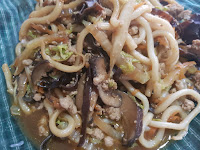
Fried Udon with Minced Meat


I fell in love with the Udon as they are smooth and chewy. While I fried it with prawns and fish balls the last round, this round I fried it with minced meat and added long cabbage, carrot, Shiitake mushrooms and woodear. And, I also fried a bigger portion so that everyone could eat to their hearts' delight. It is good for breakfast, lunch or dinner.


Ingredients (4 servings):

  • 400 g udon
  • 4 long cabbage leaves
  • 1 small carrot
  • 2 pieces Shiitake mushroom
  • 150 g minced meat
  • 4 pieces of woodear
  • 4 cloves garlic, chopped
  • 2 tbsp sesame oil
  • 2 tbsp cooking oil
  • 3 tbsp light soy sauce
  • 1 tbsp dark soy sauce
  • 1 tsp salt
  • 1/2 tsp pepper powder
  • 1 cup water

Method:
  • Wash and cut long cabbage leaves into thin strips, width-wise.
  • Grate the carrot into long strips
  • Soak Shiitake mushroom till soft. Then, slice them up.
  • Soak the woodear and cut them up into long strips.
  • Heat up sesame and cooking oil in a kuali.
    • Add Shiitake mushroom slices to the kuali. Fry them till they are fragrant.
    • Add chopped garlic and fry them till they are fragrant.
    • Add minced meat and fry till it is half-cooked.
    • Add long cabbage, carrot and the wood ear to the kuali.
    • Fry till the long cabbage and carrot are soft. (Minced meat should be cooked by now.)
    • Add water to the kuali.
    • Season with light and dark soy sauces, salt and pepper..
    • Let the sauce simmer for about 5-7 minutes.
  • At the same time boil a pot of water using the other burner.
    • When the water is boiling, add udon to the pot.
    • Gently use a fork to loosen the udon.
    • Once they have loosened, pour them immediately into a colander to drain off the water.
  •  Add udon to the kuali and fry it for a short while.
  • Ladle the udon onto a plate and serve hot.
  • You can serve it with a topping of chili padi, fried shallots, fried onions or scallions.

Saturday, February 6, 2021

Egg Tofu with Mixed Vegetables


I always have egg tofu and mixed vegetables in my fridge, the egg tofu is usually for steaming with pork or braising with fish and the mixed vegetables for frying rice. Having these ingredients ready, it was easy to dish up Egg Tofu with Mixed Vegetable, a delicious dish for either lunch or dinner. 


Ingredient:
  • 2 tubes of egg tofu
  • 150 g mixed vegetables
  • 6-8 pcs of prawns, shelled and de-veined
  • 1 egg
  • 2 cloves garlic, chopped
  • 3 tbsp corn flour / tapioca flour / potato flour
  • 1/2 cup water
  • 2 tbsp light soy sauce
  • 1/2 tsp salt
  • 1/2 tsp white pepper powder
  • Cooking oil


Method:
  • Heat wok with cooking oil.
  • Cut egg tofu into 1-cm height.
  • Coat with flour and gently put them into wok.
  • Fry them till both sides are golden brown. Ladle up and set aside.
  • Remove oil from the wok leaving about 2 tablespoons.
  • Add garlic to the wok and fry them till they are fragrant.
  • Add prawns and mixed vegetables to the wok and fry them till the prawns are cooked and the mixed vegetables are softer.
  • Add water to the wok and let it boil.
  • Beat the egg and drop it into the wok stirring the water in a circular movement.
  • Add fried egg tofu to the wok.
  • Add light soy sauce, salt and pepper to the wok.
  • Let the sauce simmer for about 10 minutes.
  • If the sauce is too watery, add some water to the remainder of the flour which was used for coating the egg tofu earlier, stir it and pour it into the wok, gently stirring the ingredients.
  • Dish up and serve.

Tuesday, February 2, 2021

Chicken Floss


Chicken Floss (or Kei Bak Hu in Hokkien) is a good accompaniment for white porridge and even rice. It can also be eaten on its own or spread on bread for breakfast or tea time. It is very expensive if we were to buy from those shops selling bak kwa and meat floss. As it is so easy to make, why not make it ourselves. 

Ingredients:

  • 400 g chicken breast (without skin and bones)
  • 4 slices of ginger
  • 3 cloves of garlic (whole)
  • 1/2 tsp salt
  • 3 tbsp brown sugar
  • 1 tbsp light soy sauce
  • 1 tbsp cooking oil
  • Water, enough to cover the chicken breast

Method:
  • Boil the chicken breast in a pan with enough water to cover it.
  • Add ginger slices, garlic cloves and salt to the pan.
  • Cover the pan and boil till the chicken meat is soft. (If you prefer long strands of chicken floss then do not over boil the meat.)
  • Remove and discard the ginger and garlic.
  • Remove excess chicken broth. (Do not discard. You may use the broth to cook porridge.)
  • Add sugar and light soy sauce to the chicken.
  • Stir the chicken over very low fire. As you stir break down the chicken into strands by pressing the chicken against the base of the pan.
  • Stir until dry.
  • Heat up kuali with 1 tbsp cooking oil.
  • Transfer chicken to kuali and keep on stirring the floss under very low heat (to prevent burning) till it is very dry and golden brown. Fry longer if you want it to be more crunchy.
  • Once done, spread it out on a metal plate to cool down.
  • Transfer it to a glass bottle for keeping.